
- 0xdurakiModulated Square Wave Signals
A Modulated Square Wave is a series of High/Low signals repeated rapidly.
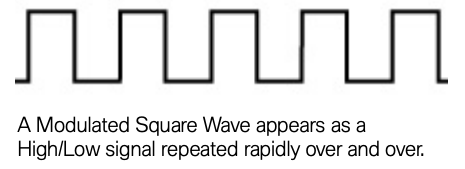 A Modulated Square Wave appears as a High/Low signal, repeated rapidly over and over
Like the switched signal B+ and B-, the square wave has only two voltage levels. These are: High Level and Low Level.
A modulated square wave has 3 characteristics that can be modified to vary the required signal:
- Frequency
- Pulse Width
- Duty Cycle
Frequency
The frequency of a modulated square wave signal is the number of complete cycles or pulses, that occur in one second (fq = O(cycle)^1sec). This number of cycles (or frequency) is expressed in Hertz (Hz). 1Hz = 1 complete cycle per second.
An output function may use a fixed or varied frequency.
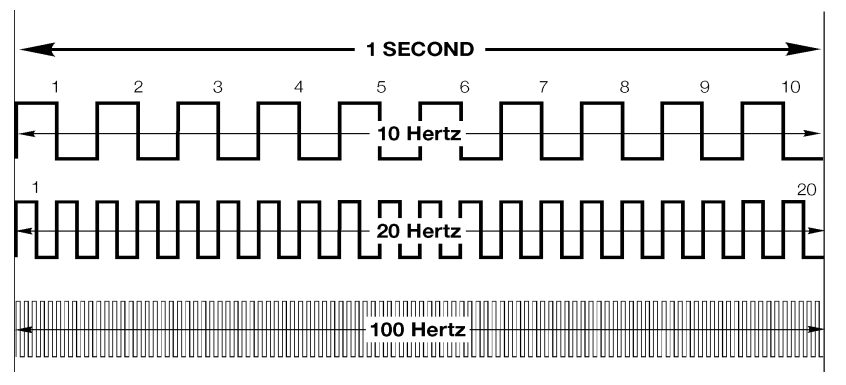 Different number of cycles per one (1) second - e.g. Frequency Herz
In the above picture, we can conclude: if 10Hz/sec then the sensor operates at frequency of 10Hz, else it’s operating on 20Hz, 100Hz and so on.
The frequency is fixed if the cycles operating in one second is constant. If cycles operating in one second is not constant, we call them varied frequency.
Typical Application of Fixed and Varied Frequency
Fixed
- Throttle command from EMS2000 to EDR
Varied
- Hall Effect Crank Sensor
- Hall Effect Wheel Speed Sensor
- Hall Effect Camshaft Sensor
Pulse Width
The Pulse Width of a signal is the length of time a pulse is running. Vehicle systems may use fixed or varied ON times/pulse width. Pulse width is expressed in milliseconds (ms).
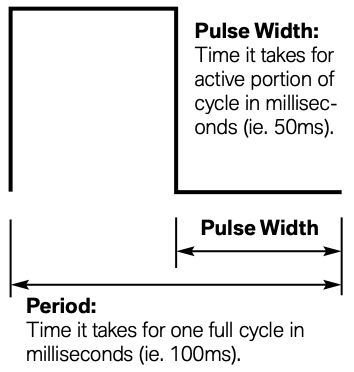 Pulse Width - Time it takes for a single portion of a Frequency Cycle (in milliseconds)
In above example, a period of a full cycle equals to pulse width multipled by twice; (since a cycle has a high cycle, and low cycle) - ON/OFF state.
Blog post titled Introduction to PWM - Pulse Width Modulation provides easy to understand information how is PWM used to generate analgue signals to a digital device such is MCU. Alternatively, read the blog post Generating PWM Signal using AVR Timers - Part I, and Generating PWM Signal using AVR Timers - Part II to understand how PWM generation is implemented in microcontrollers.
Duty Cycle
The Duty Cycle of a Square Wave is the ratio of ON time to OFF time for one single cycle. Duty cycle is expressed in percentage (%).
In short, Duty Cycle is the ratio/percentage difference between ON/OFF Pulses. If the Square Wave signal consists of 3/ON pulses, and 2/OFF pulses, the ratio is 3/2, which means the Duty Cycle is ~150% for one signel cycle.
Vehicle systems use both fixed duty cycle signals, and also variable duty signals.
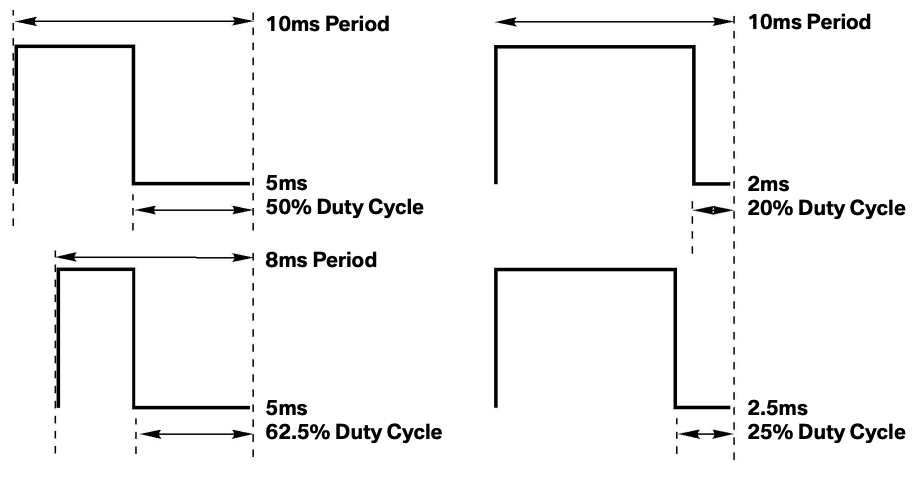 Duty Cycle ratio in different cycle signals
Time
- 1 second = 1000 milliseconds (ms)
- 1/4 second = 250 milliseconds
- 1/100 second = 10 milliseconds
- 1/2 second = 500 milliseconds
- 1/10 second = 100 milliseconds
- 1/1000 second = 1 millisecond